Translation
Translated from the Spanish source, which is the normative text. Status: draft pending human review. Differences are resolved in the Spanish text.
AI, assistants and agents: methodology scope
ASILO and SCAFFOLD include work with artificial intelligence (AI). They do not require a multi-agent system. ASILO bounds systems built with AI assistance and model uses that activate its requirements; SCAFFOLD manages software projects built with AI, from framing to delivery. MILPA preserves knowledge and provenance in both contexts.
Terms to distinguish
| Term | Meaning here |
|---|---|
| AI | A field and techniques used to produce predictions, content or decisions; it does not identify an architecture by itself. |
| Model | A component processing input and producing output; using a model does not imply several agents. |
| AI assistant | A tool supporting a person in a task, such as writing, analysis or programming. |
| Agent with tools | A component with identity and scope that can act through tools or access data. ASILO-R-004 conditions apply. |
| Multi-agent system | A system coordinating several agents. It is one application case, not an entry requirement of ASILO or SCAFFOLD. |
Three situations, not a maturity ladder
flowchart TD
  accTitle: AI scope and application conditions
  accDescr: The branches are situations, not maturity levels. Requirements retain their own conditions.
  T["Task or system with AI assistance"] -->|model producing content| M["Interaction with a model"]
  T -->|construction support| S["One person and one assistant"]
  T -->|additional coordination| V["Several people or assistants"]
  M --> C["ASILO: requirements according to their conditions"]
  S --> C
  V --> C
  S --> E["SCAFFOLD: software projects with people and AI assistants"]
  V -->|when building software| E
  C --> R["MILPA: project sources, authority and evidence"]
  E --> R
SVG diagram: AI scope and application conditions · Editable Mermaid source.
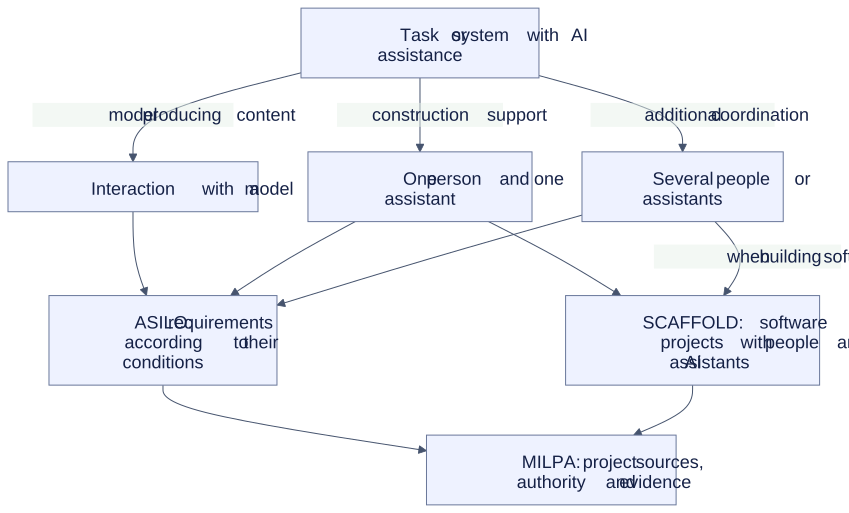
Arrows separate situations and related methods. They require no sequence and do not mean that several AIs provide greater certainty. A single assistant can build software; a model can produce content without using tools; several agents introduce coordination risks. Each project records its case.
Application conditions that remain in force
| Requirement | Relevant condition |
|---|---|
| ASILO-R-001 | Effect points fed by a model. Shape validation proves neither truth nor authorisation. |
| ASILO-R-002 | More than one module or package in a system declaring ASILO; no layer count is imposed. |
| ASILO-R-008 | Before claiming fitness publicly or to a customer, and on each relevant change of model or configuration. Failures between agents apply when there is more than one. |
| SCAFFOLD-R-002 | A change touches several owners’ zones; this does not require creating several agents. |
| SCAFFOLD-R-005 | The assistant changes within a batch. |
| SCAFFOLD-R-016 | One batch depends on another, even if the same person runs both. |
This table is guidance: complete records govern scope, actor, evidence, exceptions and residual risk. A summary, diagram or guide does not extend accepted obligations.
ASILO: building with AI and systems that contain AI
The table compares two situations: (a) the system contains a model or an agent; (b) the system is only built with an AI assistant and contains none. Each quotation comes from the scope or the applicability condition of the record.
| Requirement | Quotation from the record | (a) Contains a model or agent | (b) Only built with an assistant; contains none |
|---|---|---|---|
| ASILO-R-001 | Condition: "Whenever there is at least one effect point fed by a model." | Yes, if a model feeds at least one effect point; if it only shows text to a person, the exception is recorded. | Not in the built system. Effects of the assistant during construction: depends on the profile / see the record. |
| ASILO-R-002 | Condition: "Systems with more than one module or package that declare that they apply ASILO." | Yes, with more than one module or package and ASILO declared. | Same as (a): the condition does not depend on a model being present. |
| ASILO-R-003 | Scope: "Each task in which an agent or model receives context"; condition: "with access to internal sources, personal data or persistent memory". | Yes, in tasks of the model or agent with that access. | Depends on the profile / see the record. |
| ASILO-R-004 | Scope: "Agents, subagents and tools that execute actions."; condition: "Any agent with access to tools or data." | Yes, for each agent with access to tools or data. | Yes, if the assistant acts as an agent with access to tools or data; otherwise, no. |
| ASILO-R-005 | Condition: "When an action belongs to the catalog of critical effects or the system cannot decide with its rules." | Yes, when the condition is met. | Yes, when the condition is met; it does not depend on a model being present. |
| ASILO-R-006 | Scope: "Personal data, data of minors, credentials and confidential data"; condition: "Whenever the system processes any of that data." | Yes, if the system processes that data. | Yes, if the system processes that data; it does not depend on a model being present. |
| ASILO-R-007 | Scope: "Agent runs and model calls with cost or effect."; condition: "Any automated run with cost or effects." | Yes, for runs and calls with cost or effect. | Depends on the profile / see the record. |
| ASILO-R-008 | Scope: "Systems that use models to produce content, decisions or actions […]"; condition: "Before claiming publicly […] that the system is fit". | Yes; failures between agents only if there is more than one. Marked internal prototypes are the record's exception. | No: the scope is systems that use models. |
This table is a reading aid; where it differs from the record, the record prevails.
Small examples
- A person uses AI to write code: SCAFFOLD organises zones and batches; ASILO bounds relevant context and actions; MILPA records sources and decisions. The final product may not use AI.
- An application queries a model for a summary: ASILO guides contracts, data and evaluation under applicable conditions; SCAFFOLD describes construction when it uses AI assistance.
- A team coordinates several assistants: the same distinctions remain, with handoffs, dependencies and failures between agents reviewed where relevant. Quantity does not replace evidence.